How to Start Strength Training After 40 | Beginner's Guide
Last month, we talked about why strength training matters so much for women after 40.
Maybe you finished reading and thought, "Okay, I'm convinced… but where do I even start?"
If that was you, this post is for you.
You don't need a fancy gym, a perfect plan, or years of experience. You just need a simple place to begin. Let's walk through it together.
First, Let's Talk About the Worries
When women tell me why they haven't started lifting, I usually hear some version of these:
"I'm afraid I'll get hurt."
"I don't know what I'm doing."
"The weight room feels intimidating."
"Isn't it too late for me?"
If any of those feel familiar, you're in good company.
According to CDC survey data, fewer than 1 in 4 U.S. adults meet the recommended guidelines for both cardio and strength training. So if you're just starting, you're not behind. You're right where most people are.
And here's the encouraging part: it is not too late. Research consistently shows that muscles respond to strength training at every age, even well into our 70s and 80s. Your body is ready to adapt. It just needs a reason to.
How Often Do You Need to Train?
Less than you might think.
The U.S. Physical Activity Guidelines recommend strength training at least 2 days per week, working all your major muscle groups.
That's it. Two sessions. About 20 to 30 minutes each is a great place to start.
You don't need to train every day. In fact, your muscles get stronger during the rest days in between. Recovery is part of the plan, not a break from it.
The 5 Moves That Cover It All
Strength training can feel overwhelming because there are so many exercises out there.
But almost everything comes back to five basic movement patterns. These are the same movements you use in everyday life.
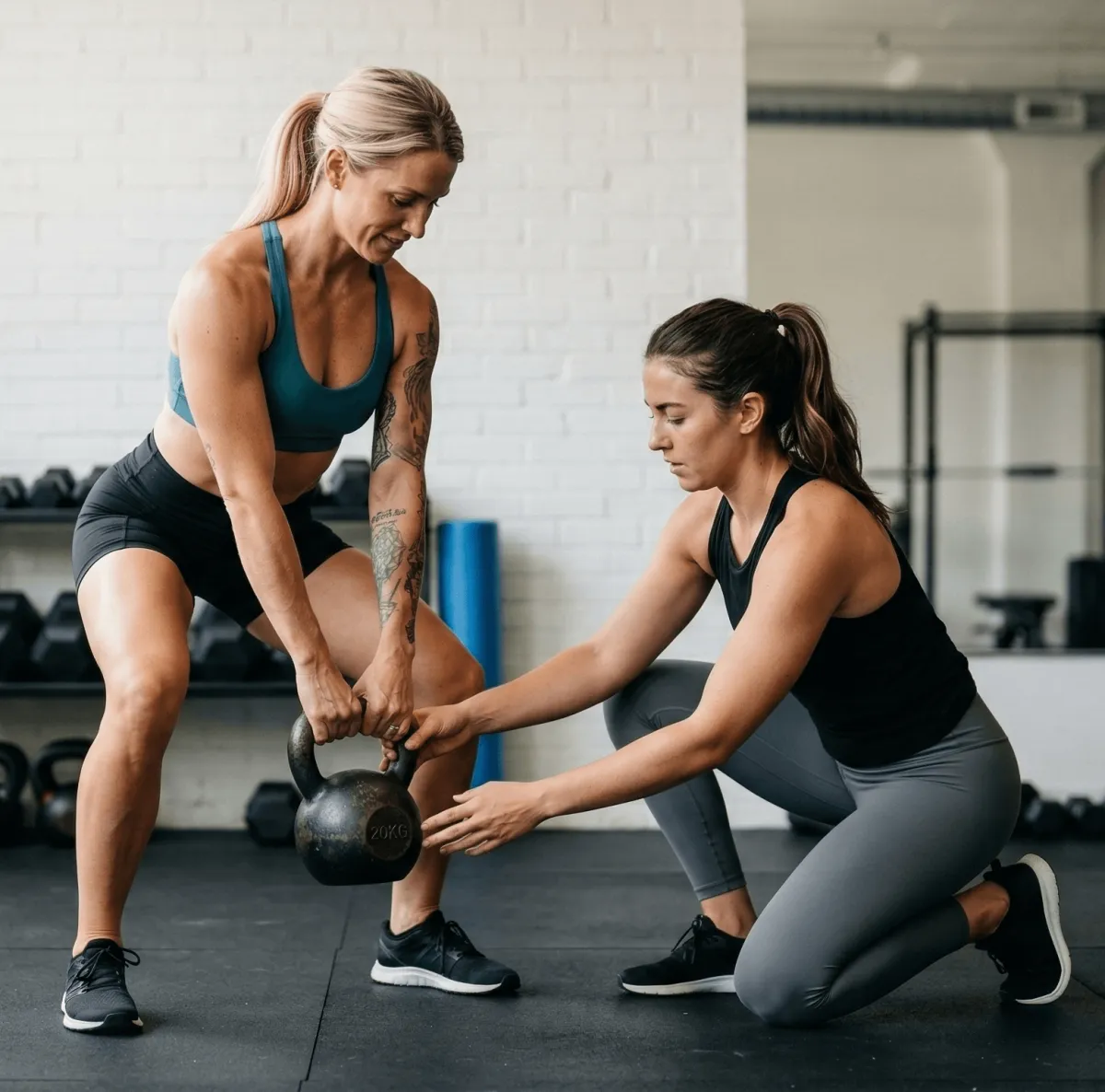
Squat: sitting down and standing up. Start with a chair squat, lowering yourself to a chair and standing back up.
Hinge: bending at the hips, like picking up a laundry basket. Start with a glute bridge or a light dumbbell deadlift.
Push: pushing something away from you. Start with a wall push-up or an incline push-up on a counter.
Pull: pulling something toward you, like opening a heavy door. Start with a resistance band row or a one-arm dumbbell row.
Carry: walking while holding something, like groceries. Start by holding a dumbbell in each hand and walking for 30 seconds.
Your Simple Starter Week
Here's an easy way to put it all together. You can do this at home with a chair, a set of light dumbbells, and a resistance band.
Do this same workout twice a week, with at least one rest day in between (for example, Monday and Thursday).
Exercise | Sets | Reps |
|---|---|---|
Chair squat | 2 | 10 |
Glute bridge | 2 | 10 |
Wall or incline push-up | 2 | 8 to 10 |
Band or dumbbell row | 2 | 10 each side |
Dumbbell carry | 2 | 30 seconds |
Start with a 5-minute warm-up, like marching in place, arm circles, or a brisk walk.
Rest about 60 seconds between sets. Move slowly and with control. There's no prize for rushing.
How Heavy Should You Go?
This is one of the most common questions I get. Here's a simple rule:
Choose a weight where the last 2 or 3 reps feel challenging, but you could still do 2 or 3 more with good form.
If you can easily do 15 more, it's too light. If your form falls apart, it's too heavy.
How to Keep Making Progress
Your body adapts to what you ask of it. So, over time, we gently ask for a little more.
Once an exercise starts to feel easy, try one of these:
Add 1 or 2 more reps
Add a third set
Move up to a slightly heavier weight
Change just one thing at a time. Small, steady steps are what build lasting strength.
One more thing: it's normal to feel a little sore for a day or two after your first few sessions. That usually fades as your body adjusts. Sharp or lingering pain is different, so listen to your body and check in with your doctor if something doesn't feel right.
How to Know It's Working (Hint: It's Not Just the Scale)
In the first few weeks, much of your progress happens behind the scenes. Your brain and muscles are learning to work together, which is why beginners often get stronger quickly.
So instead of watching the scale, notice the little wins:
Getting up from the floor feels easier
Carrying groceries up the stairs takes less effort
You're sleeping a little better
You feel steadier and more confident in your body
The weight that felt heavy in week one now feels manageable
These moments matter. Write them down. They're proof you're getting stronger.
You Don't Have to Do This Alone
Starting something new after 40 takes courage. I see that, and I'm proud of you for even considering it.
Remember, the goal isn't perfection. It's consistency. Two short sessions a week, done with care, can change how you feel in your body.
Start where you are. Use what you have. Celebrate the small wins.
Strength is just one part of the story.
Real, lasting change happens when your mind, your food, and your training all work together. That's the heart of how I coach.
If you're ready to invest in yourself, not just in a workout plan but in how you think, eat, and move, I'd love to talk.
You're stronger than you think. Let's prove it together.
Note: If you have a health condition, injury, or haven't exercised in a while, check in with your doctor before starting a new program.